
Solo design studio · Orbital logistics concepts
The hull, internals, rigging, and the full animation pipeline have been released for anyone to use, extend, or cite. Consider it my argument that orbital logistics deserves to be taken seriously.
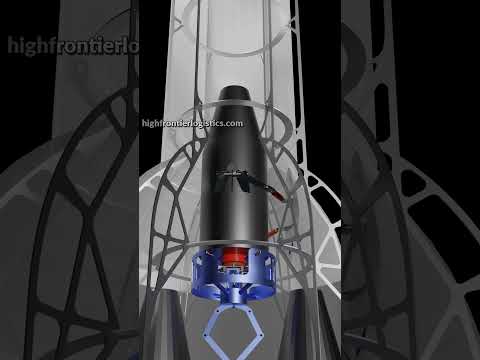 Payload Receiving
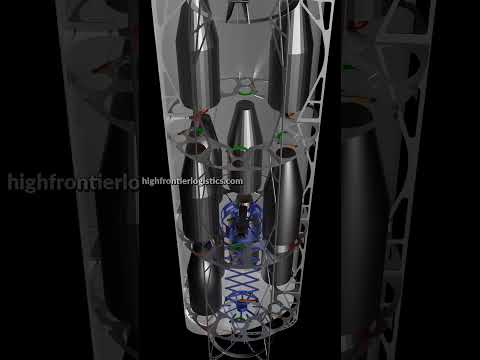 Payload Berthing
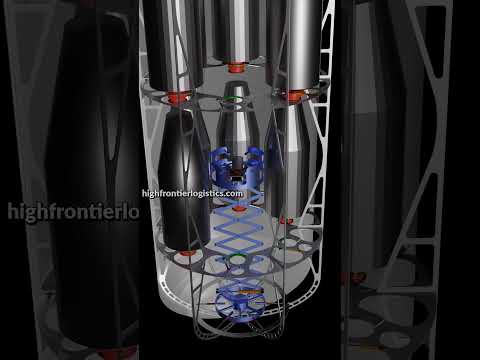 Loader Parking
Saved in Blender 5.1.2 - requires 5.1.2 or newer (free at blender.org)
Open source doesn't mean "here's the renders." It means the actual source files and everything you'd need to pick up where I left off, adapt the design, or build your own argument on top of it. Here's what's in the repository.
License: Repository scripts and helper code under MIT. Design files, geometry, renders, animation, and thesis text under CC BY-SA 4.0. Attribution: "High Frontier Logistics / Wesley E. Corp" highfrontierlogistics.com.
Why open source this at all? Because the best outcome isn't that I build this, it's that the idea survives long enough to influence someone who can. Locking geometry behind a personal project doesn't serve that. A public repository does.
It's an orbital tender, a vessel that accepts, stores, services, and redeploys Starship-class payloads. Think less "spaceship" and more "container port that happens to be in orbit." Every ton of material that leaves Earth needs somewhere to go before it arrives. The tender is that somewhere.
A payload is a payload. The tender doesn't care what's inside the container. If it fits a standardized cargo envelope, there's a berth for it. Standardized interfaces, agnostic handling. The whole design philosophy is boring on purpose: open architecture, no proprietary couplings, the same design repeated so it scales in 6-bay increments.
Opening the source files is a continuation of that philosophy. The architecture was designed to be extended without a redesign. The repository is the same idea, fork it, add bays, propose a different berthing mount and then discuss, critique, and revise.
Short answers to common questions. The technical claims are grounded in the modeled files, stated assumptions, or linked references.
Not seeing what you need? Contact [email protected].
Honesty is the whole pitch here. The left column is geometry I actually modeled. You can see all of it in the animation, and all of it ships in the repo. The right column is drawn from published physics and launch-economics projections: plausible, but not mine and not yet proven. The same distinction carries into the model itself.
In the animation and in the repo
Projections, please verify independently
The repo carries the same notation. Files are explicit about which claims are modeled geometry and which are external projections.
Almost everything else in this model is about this specific tender: its bay count, its mobility system, its internal logic. The berthing mount is different. It's the one component whose entire value depends on showing up on hardware this project doesn't control.
Every payload arrives fitted with a standard coupling, visible as the red/orange ringed fitting at each bay boundary in the animation. It does two jobs with one fitting:
This isn't drawn from an existing standard, there isn't one yet. It's a proposal: one fitting, two functions, meant to be copied onto payloads built by people who never look at the rest of this model. If a coupling standard for orbital cargo handling is going to exist, it has to start somewhere. This is a starting point open for discussion, critique, and revision.
You don't colonize a continent from the beach, you build a port first, a place to dock, refuel, repair, and redistribute. For expansion off Earth, the natural site for that port is a Lagrange point. The mechanics are real; the infrastructure case is the proposal.
The real advantage of L4/L5 isn't fuel savings, station-keeping at L1/L2 is cheap anyway, a few tens of m/s a year. It's passive stability: lose power or comms at L1 and your facility drifts off. At L4/L5 it remains naturally confined near the stable region instead of quickly departing, though real hardware would still need navigation and occasional correction. For cargo sitting idle between missions, that passive hold is worth more than the trivial fuel difference.
Why L5 specifically? Mostly history. L4 and L5 are physically identical, either works. L5 got its name recognition because Gerard O'Neill used it in The High Frontier (1976) and the L5 Society ran with it. In practice you'd pick whichever fits your traffic pattern, or use both. The point was never which Lagrange point. It's that the port gets built at all.
The design didn't come out of nowhere. It comes from a pattern that holds across most of economic history: the durable winners aren't the ones who make the goods, they're the ones who move, hold, and hand them off. Venice controlled the routes, not the spices. Containerization reshaped the world with one standardized box. Logistics is the layer everything has to pass through, and space is about to have that problem with almost no one building for it. I'm not claiming certainty on the timeline, I'm claiming the bottleneck is real and worth designing for now.
Reusable launch is changing what's physically liftable, not just what's affordable. Once mass to orbit gets cheap enough, the constraint moves from "can we launch it" to "where does it go once it's up there."
Lots of people build rockets. Lots imagine habitats. Very few are designing the unglamorous middle layer, the thing that catches, holds, and hands off cargo in orbit. That's the tender: a container port that happens to be in orbit.
If longevity research delivers even part of what's hoped, and senolytics and reprogramming are in human trials now, people build on longer time horizons, which makes durable orbital infrastructure more valuable. I find this compelling but hold it loosely; the logistics argument above doesn't depend on it.
The short version: cheap heavy lift changes where people build. The constraint becomes orbital handling, receiving, holding, and redeploying cargo, and almost no one is designing for it. That gap is the tender. The full argument, including the longer-horizon case, is in the repository.
I designed and created this work, but this didn't happen alone; a lifetime of support from family, friends, and cohorts made it possible.
I'm Wes Corp, an independent designer in Idaho with a hands-on workflow spanning mechanical design, CAD, animation, Linux, local AI, robotics, and web infrastructure. I'd rather produce an animated working model than present slideware about one.
The tender was designed end to end with my CAD workflow, geometry, rigging, and animation, which is why I can show it moving instead of just describing it. And that's why you can open it and change it yourself.
Major background claims and external assumptions are linked below for independent verification.
All forward-looking projections are speculative and subject to change. This site does not provide investment advice. For specific data sources or methodology questions, contact [email protected].
To be clear about what this is and isn't: it's a design and a thesis, now public. There's no fund, no raise, no product. And here's the honest part: making it open source was the only thing on this page I actually controlled. What happens next isn't up to me, and that's the point.
The full Blender source file went public, hull, internals, rigging, and animation pipeline. Repository scripts and helper code under MIT, CC BY-SA 4.0 on design files, geometry, renders, and animation. Everything needed to build on it, fork it, or argue with it.
v1.0.0 ships the complete Blender file and the design thesis together, the geometry, the rendered stills, and the written argument for orbital logistics as infrastructure. The thesis makes explicit which claims are modeled and which are external, so the conversation can be about the idea, not about what the idea is.
Maybe the repository sits untouched. Maybe someone forks it and builds something I never imagined. Maybe the idea gets torn apart and something better replaces it. None of that is mine to decide, and an open release means the concept survives, or doesn't, on its own merits, not on whether I personally can carry it. That's a feature, not a risk.
The complete Blender model, renders, thesis, and helper files are public on GitHub. Download the .blend, fork the repository, or share the project with someone who studies orbital logistics, robotics, berthing, docking, or space infrastructure.
Saved in Blender 5.1.2 - requires 5.1.2 or newer (free at blender.org)